
What’s Changing
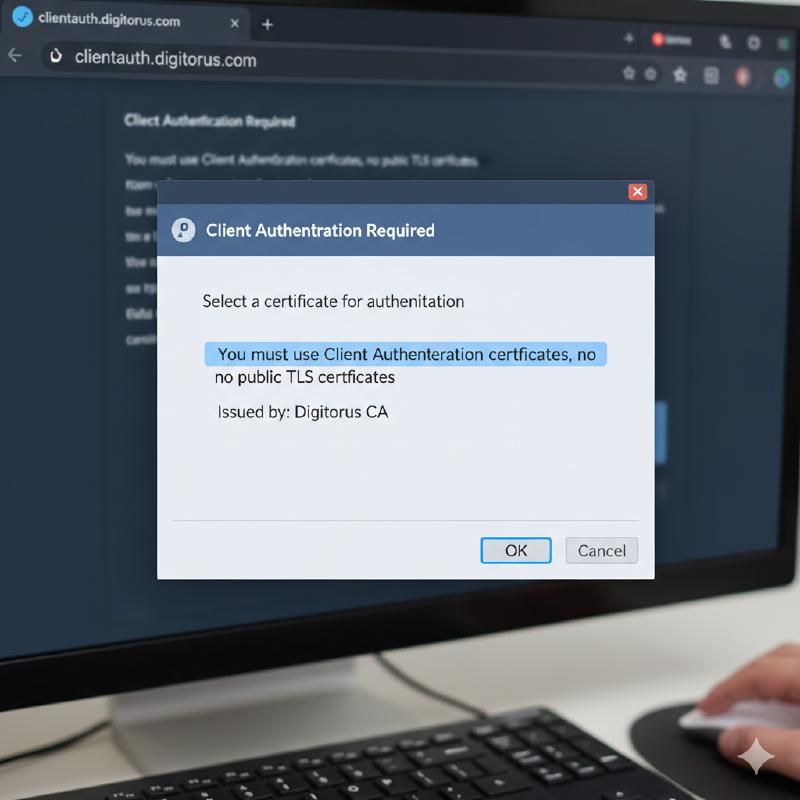
The End of Public Client Authentication
This change is coming from the Google Chrome Root Program (not the CA/Browser Forum), and in practice it applies to all public CAs that want to remain trusted in Chrome. The CA/Browser Forum may later follow with an alignment ballot, but the operational impact for relying parties is the same.
This direction has been discussed and anticipated for years: browsers have steadily narrowed the WebPKI’s scope to public server authentication, not general-purpose client identity.
Two deadlines, one direction
Chrome phases the change in over two dates, defined in the Chrome Root Program Policy (v1.8):
Effective 15 June 2026 — issuing CAs (already in force): every subordinate CA certificate disclosed to the CCADB on or after this date, operated beneath a root in the Chrome Root Store, MUST include the extendedKeyUsage extension and only assert an extendedKeyUsage purpose of id-kp-serverAuth. No new dual-purpose (serverAuth + clientAuth) issuing CA can enter a Chrome-trusted hierarchy, so the pool of public CAs still able to issue clientAuth is frozen and shrinking.
Effective 15 March 2027 — subscriber certificates: all corresponding unexpired and unrevoked subscriber certificates issued on or after 15 March 2027 MUST include the extendedKeyUsage extension and only assert an extendedKeyUsage purpose of id-kp-serverAuth.
This change separates the WebPKI’s role (public server authentication) from the role of client identity and access control (private client authentication). It affects any environment using publicly trusted certificates for client authentication, both browser and non-browser, such as VPN access, API gateways, device authentication, or internal service mesh communication.
This does not mean you can’t use client authentication or mTLS; it means client certificates should come from a Private PKI (or equivalent) while server certificates remain publicly trusted for serverAuth.
Scope note: This change is about publicly trusted TLS certificates (the WebPKI). It does not inherently prevent other certificate use cases (for example S/MIME or internal signing/sealing certificates) from including clientAuth, but it’s still recommended to consider a purpose-built clientAuth issuing CA for client identity.
More broadly, expect that root programs may continue to tighten and refine what is acceptable in publicly trusted certificates, and similar constraints could expand to additional public certificate profiles over time.
Key Dates
Public CAs are not waiting for the root program deadline, and their own dates are the ones that decide when your renewals silently lose the clientAuth EKU. The examples below are indicative; always confirm the exact cut-off with your own CA, including for renewals, reissues, and duplicates.
- 1 Oct 2025
- clientAuth off by default
- DigiCert stops including clientAuth in public TLS certificates by default; it remains available on request.
- clientAuth off by default
- 11 Feb 2026
- Let’s Encrypt
- clientAuth dropped from the default ACME profile; the temporary
tlsclientprofile carried it only through mid-2026.
- clientAuth dropped from the default ACME profile; the temporary
- Let’s Encrypt
- 15 Jun 2026
- Chrome: issuing CAs
- Newly disclosed subordinate CAs in Chrome-trusted hierarchies must assert id-kp-serverAuth only.
- Chrome: issuing CAs
- 10 Feb 2027
- Sectigo
- Announced hard stop: no clientAuth in any SSL/TLS certificate.
- Sectigo
- 1 Mar 2027
- DigiCert
- Announced hard stop, including renewals, reissues, and duplicates.
- DigiCert
- 15 Mar 2027
- Chrome: subscriber certificates
- All newly issued public TLS certificates must assert id-kp-serverAuth only. Maximum validity drops to 100 days on the same date.
- Chrome: subscriber certificates
- Autumn 2027
- Last dual-EKU certificates expire
- A certificate issued just before 15 Mar 2027 can be valid for at most 200 days, so publicly trusted clientAuth certificates disappear from production around the end of September 2027.
- Last dual-EKU certificates expire
Several CAs, including the large ACME providers, have already stopped issuing publicly trusted TLS certificates that include clientAuth. If you are still receiving them today, you are on borrowed time from a shrinking set of issuers.

Direct Impact of clientAuth EKU Removal
| Scenario | Public Certificate Usage | Risk |
|---|---|---|
| API Authentication | Used to authenticate clients/machines to API gateways. | Service Disruption (Authentication fails) |
| VPN/Device Access | Used by devices or users for network access control. | Operational Outage (Access is denied) |
| Audit/Compliance | Policies currently allow public CAs for client identities. | Audit Failure (Non-compliance with policy) |
| Routine Renewal | Existing dual-EKU certificates are renewed or reissued as usual. | Silent Breakage (The replacement certificate no longer asserts clientAuth) |
Migration Challenges and Critical Risks



How Digitorus Enables a Secure Migration
We provide a full-service strategy to manage this complex transition, ensuring a seamless move to a compliant, resilient machine identity foundation.
Phased Migration Journey
Our structured approach addresses all technical and compliance requirements before deployment. Plan backwards from your CA’s cut-off date rather than from 15 March 2027: with discovery, architecture decisions, pilots, and partner coordination in the critical path, the replacement of the last public clientAuth certificates needs to be underway well before renewals stop carrying the EKU.
- Phase 1
- Discover
- Inventory all affected certificates and map dependencies.
- Discover
- Phase 2
- Strategy
- Determine target architecture: Public, Private PKI, PKIaaS, or alternative method.
- Strategy
- Phase 3
- Implement
- Build or adopt the new CA environment and pilot enrollment and authentication.
- Implement
- Phase 4
- Migrate
- Orchestrate the systematic replacement of old public TLS clientAuth certificates.
- Migrate
Supporting Capabilities for Private PKI

Our work is practical and outcome-focused: we work with you to choose the right approach for your environment and make it operable, without forcing a one-size-fits-all “build a PKI” program. That means aligning on the key decisions together (platform, issuance model, trust distribution, key protection) and producing the governance you actually need (controls, risk assessments, and CP/CPS updates where appropriate).
For clientAuth and mTLS, we focus on what breaks in production: consistent certificate profiles (EKUs, subject/SAN strategy), reliable enrollment at scale, partner/customer onboarding, and lifecycle hygiene (renewal, rotation, revocation).

Which New CA is Right for Your ClientAuth?
Public CAs are phasing out multipurpose certs, but the alternative can be complex. Do you need a Shared Public CA or a flexible Private PKI? Get unbiased expert guidance targeted to your usecase before you choose.
Start Your Independent PKI Strategy Session